01
casting
Reading the cast skin
What a surface may reveal about mould, flow and finishing—and where visual inference must stop.
Read articleCast form / living surface / careful custody
A field review of how moulds, tools, light and time shape cast objects—and how to read that evidence without turning uncertainty into myth.
Four lines of inquiry
Each desk begins with the same discipline: describe first, source second, interpret with limits.
A cast object records modelling, gating, pouring, cooling and finishing, even when later polishing makes the process look effortless.
Enter desk ↗02Tool marks, polishing, coatings and corrosion layers determine how cast form meets light—and how cautiously it should be interpreted.
Enter desk ↗03Bosses, bands, repeated lines and relief fields can guide handling, viewing and ceremony without becoming a universal symbolic code.
Enter desk ↗04Stable surfaces and active corrosion can look similar in a photograph; preservation decisions require material knowledge, records and restraint.
Enter desk ↗Featured readings
The lead essay starts at the cast skin; the rest test sequence, surface, ornament and responsibility.
casting
What a surface may reveal about mould, flow and finishing—and where visual inference must stop.
Read articlecasting
A measured guide to direct and indirect casting, destructive models and the rhetoric of uniqueness.
Read articlesurfaces
Why green, brown and black surfaces require material context rather than romantic shorthand.
Read articlesurfaces
How directional light clarifies tool marks while also staging a persuasive—and partial—view.
Read articleornament
A practical grammar for concentric relief that avoids universal claims about symbolic meaning.
Read articleornament
How to describe cast plaques without flattening technique, court history and contested collection records.
Read articleSignature field guide / non-ranked
Sequence numbers support navigation only. Objects, processes and condition references are not scored or ranked.
Ritual vessel
Bronze · animal-form body · layered relief
Relief wraps a functional volume; no single frontal image describes the complete programme.
Open referenceRitual vessel
Bronze · three lobes · columnar legs
The transition from rounded lobe to straight leg makes casting serve an architectural silhouette.
Open referenceCourt plaque
Leaded brass · high relief · patterned field
Figure scale, centrality and regalia create hierarchy, while nail holes preserve evidence of installation.
Open referenceModern sculpture
Bronze · opened silhouette · polished planes
Projecting planes make one static cast suggest a body moving through surrounding space.
Open referenceProcess reference
Unique wax model · destroyed mould · singular route
The model’s destruction changes the evidence available after a successful or failed pour.
Open referenceProcess reference
Durable model · piece mould · repeatable waxes
Repeatability shifts creative labour across modelling, wax correction, casting and finishing.
Open referenceCondition reference
Adherent layer · varied colour · coherent surface
Green can be stable; colour must be read with adhesion, texture, history and change over time.
Open referenceCondition reference
Powder · flaking · localized change
Fresh light-green powder can be urgent, but remote colour matching is not diagnosis.
Open referenceFinish reference
Bright reflection · abrasion risk · handled edges
Brightness may record intended finish, recent polishing or repeated loss of surface detail.
Open referenceWorkshop reference
Cast mass · cut line · corrected edge
Post-cast chasing can clarify ornament while making the boundary between modelling and finishing harder to see.
Open referenceExplanatory feature
A reading sequence for any relief object. The diagram is an editorial framework, not a universal manufacturing recipe.
Read breaks, lips and trimmed joins before the polished field.
Track interval, continuity and interruption around the form.
Ask whether projection organizes handling, structure, ornament or all three.
Separate cast texture from chasing, coating, wear and corrosion.
Six observations
Transitions often carry more process evidence than broad polished fields.
Raking light reveals relief but also constructs a persuasive view.
Green, brown and black surfaces require context, adhesion and a change record.
Material analysis should not detach an object from use and collection history.
Indirect casting permits multiples while leaving room for skilled variation.
Description and documentation come before cleaning or treatment.
Five-point manifesto
Describe observable form before assigning meaning or method.
Keep material, provenance and collection history in the same frame.
Label generated, interpretive and documentary images at the point of use.
Prefer institutional records and conservation guidance to romantic shorthand.
Treat uncertainty as useful editorial information, not a defect to conceal.
Complete issue
How we research
Our article structure keeps documented fact, observation, interpretation and principle visible as different kinds of statement.
Start with museum records, public agencies and conservation institutions.
Mark documented fact, direct observation, interpretation and general principle.
Open every source, verify the object record and compare terminology.
Name image origins, uncertainty, sponsorship and meaningful updates.
Reader questions
No. Bronze names a family of copper alloys, while similar-looking objects may be brass, other alloys, plated or coated. Use object-level records or analysis.
No. Stable green patinas exist. Fresh powder, flaking and change over time are stronger warning signs, and diagnosis belongs to direct examination.
It can support questions about seams, joins and finishing, but technical imaging, measurement and records may be required to establish a method.
Only for navigation. The guide is explicitly non-ranked and moves from objects to processes and conditions.
We explain preventive principles and link to institutional guidance. Significant or uncertain objects should be assessed by a qualified conservator.
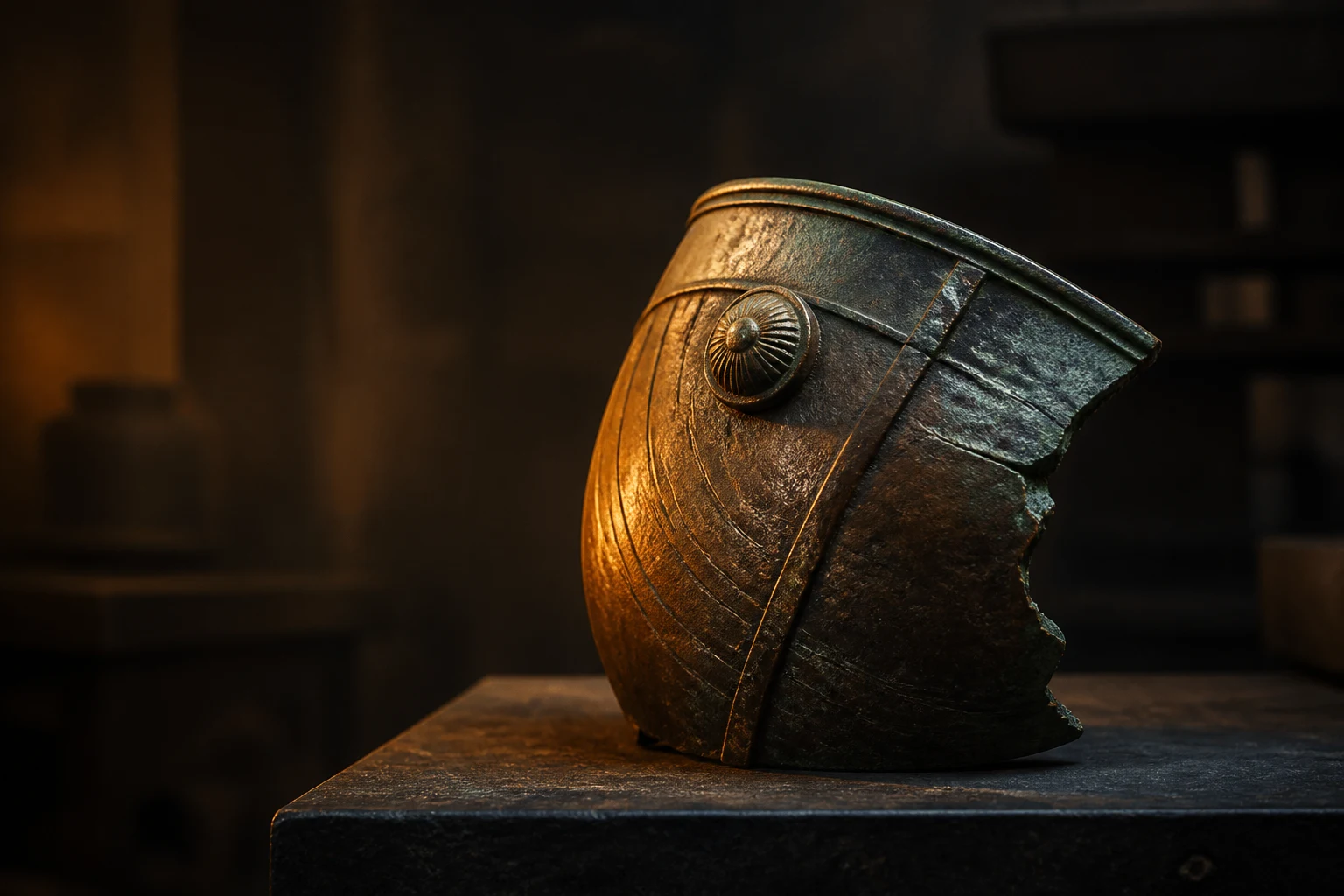
No. It is an original generated editorial image of an invented fragment, clearly labelled so it cannot be mistaken for documentary evidence.
Editorial transparency
The articles and interface are publication-ready, but the reserved .example domain, inboxes, publisher, registration and address do not assert a real business. Replace and verify them before public launch.